- Vital Sparks
- Posts
- Vital Sparks: The poetry of Judge Jackson
Vital Sparks: The poetry of Judge Jackson
An essay for Black History month

Will Fitzgerald
February 02, 2026
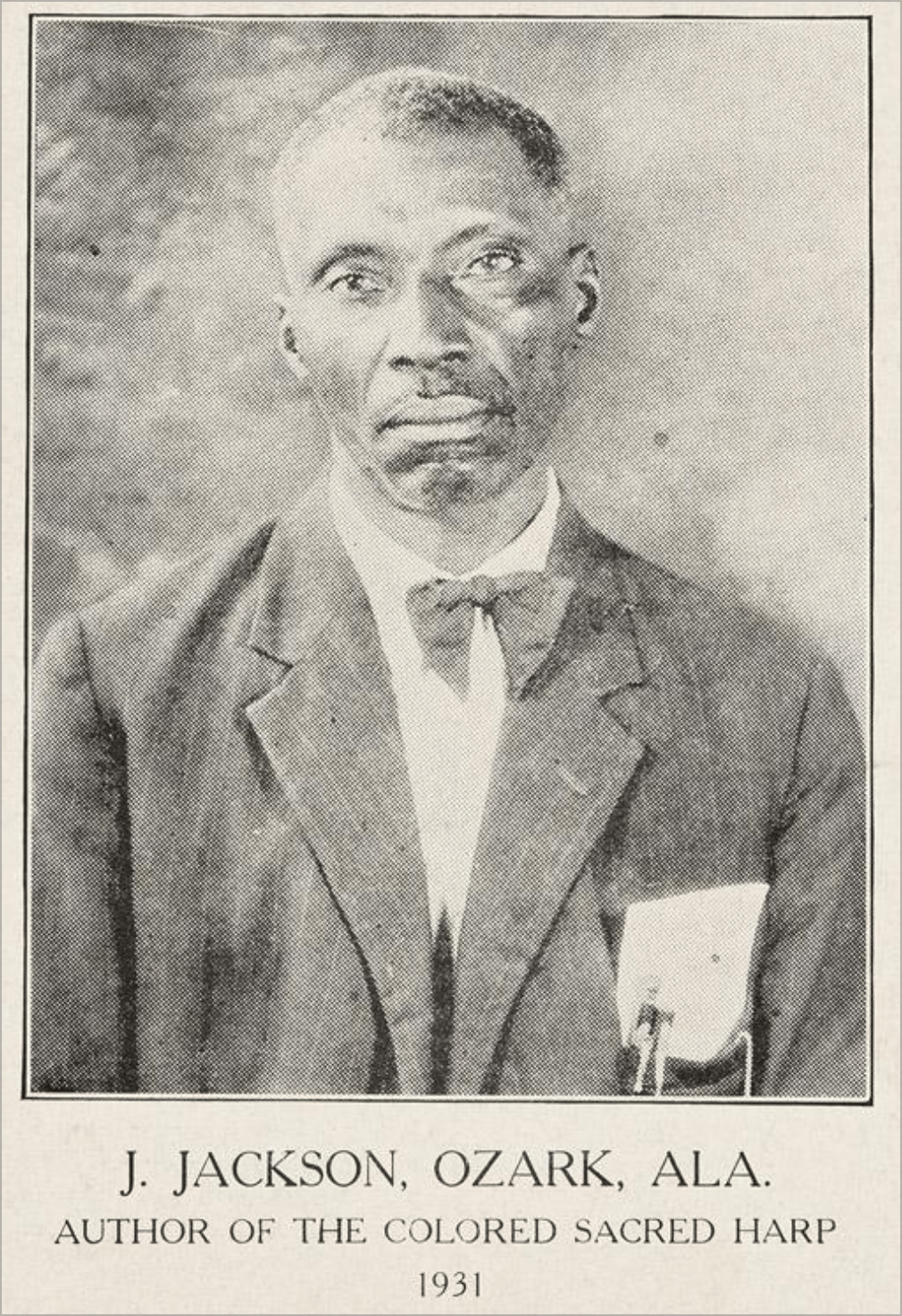
Judge Jackson
Judge Jackson was a Black Sacred Harp singer, composer, educator, and lyricist who published his own shape note tunebook, The Colored Sacred Harp, in 1934. The conception, development, and publication of this book was a remarkable feat. Judge Jackson was a remarkable man.
Jackson’s story is well told in Joe Dan Boyd’s Judge Jackson and The Colored Sacred Harp, which also describes the reception history of Jackson’s tunebook. Jesse P. Karsberg’s dissertation, Folklore’s Filter: Race, Place, and Sacred Harp Singing does a good job of describing how Jackson’s work has been treated by researchers of the shape note tradition. I don’t think anyone, however, has looked with particular scholarly attention to the lyrics Jackson provided for his compositions in The Colored Sacred Harp. In this essay, I will pay some attention, and leave it up to the scholars to furnish a more complete story.
Jackson wrote the plurality of the tunes in The Colored Sacred Harp, and arranged or added parts to several others. I will focus here on the tunes he himself composed. I think the lyrics fall into three main categories: texts from the Cooper book edition of The Sacred Harp, texts from other books, and lyrics he wrote himself. The Colored Sacred Harp follows the structure and layout of The Sacred Harp, with one important exception. In The Sacred Harp, the poet or source of the lyrics is found in the upper-left corner of the song. But, in The Colored Sacred Harp, that space seems to be used to cite the musical arranger of the song. For example, the first song in the book, 3 AM I A SOLDIER OF THE CROSS, the composer is listed as “J. Jackson” (meaning Judge Jackson) in the usual location: the upper-right corner. But, in the upper-left corner, rather than citing Isaac Watts as the poet, it says “J. J.,” indicating, I believe, that Jackson arranged his tune with bass, treble, and alto parts. This is explicit in 4 PROSPERITY, where the composer is listed as “H. Webster Wood,” but in the upper-left corner, it says, “Bass, Alto and Treble by J. J.” This makes it somewhat difficult to definitively assign texts to Jackson. Provisionally, I have assigned him as the poet for any song which is not found in the The Sacred Harp or other published sources.
Perhaps the best known tune by Jackson is 87 FLORIDA STORM, which tells the story of the 1926 hurricane that hit Miami. It’s a very unusual and very moving story ballad. It’s unusual in that such specific stories are not found elsewhere in The Sacred Harp tradition. It’s so moving because it describes the devastation of the hurricane, and how the storm affected white and Black folk in an equally devastating manner.
September eighteenth, nineteen hundred and twenty-six,
The people cried mercy in the storm,
Their cries were too late, their crying was in vain,
Crying Lord have mercy, in the storm.
[chorus]
The people cried mercy in the storm,
The people cried mercy in the storm,
The colored and the white stayed awake all the night,
Crying Lord have mercy in the storm.
A pity and a shame all the people in the rain,
But God show'd His mercy in the storm,
It was very sad that they lost all they had,
Crying Lord have mercy in the storm.
The wind with a mighty sound laid many buildings down,
But God show'd His mercy in the storm,
Night comes on you know they had nowhere to go,
Crying Lord have mercy in the storm.
The streets were all a mess it was so no one could pass,
Mothers looked for children in the storm,
Fathers tried in vain it was a shame I know,
Crying Lord have mercy in the storm.
The doctors got the news so many that were bruised,
Together with the Red Cross on the train,
They all came in haste to see about their case,
Crying Lord have mercy in the storm.
According to Boyd, this poem was written by Frank Spencer, who is otherwise unknown: a broadside sheet was found among Jackson’s papers with Spencer’s name as the author. This poem is not one of Jackson’s creation, although Boyd says “Jackson selected five stanzas which appealed to him and rewrote them slightly to conform to the tune’s metrical requirements.”
Based on my count, Jackson wrote the lyrics to eight tunes. He definitely wrote the lyrics to 19 MY MOTHER’S GONE (also now published in the Cooper book as 519, with the same name), because this is one of the rare times when the author of the words are explicitly mentioned: “Words arranged by J. Jackson, Ozark Ala., December 26, 1904. set to music August 26, 1927.” As you can see, Jackson could be meticulous in recording when he created his music. The lyric is a camp meeting style song, with an easily changeable phrase at each stanza.
I have a father (mother, brother, sister) way in glory,
One by one we’ll gather home.
[chorus]
Gathering, gathering,
One by one we’ll gather home;
Gathering, gathering,
One by one we’ll gather home.
The last stanza changes the whole first line, however, which is somewhat unusual. It looks to the return of Christ and the last judgment:
When Christ will say, “Well done,” my brother,
One by one we’ll gather home.
The rest of Jackson’s lyrics in The Colored Sacred Harp—that is, the ones I believe he wrote—are interesting because they tend to be rather free-flowing in their texts and rhymes, unlike most strophic songs in the Sacred Harp tradition. For example, consider 54 JESUS CALLS FOR THEE:
In this world below there’s sin you know
But Jesus calls for thee.
In the walk of life there’s care and woe,
But Jesus calls for thee,
Just now yes He calls.
[chorus]
But Jesus calls for thee to come,
Hear him calling for thee to come just now.
His loving sweet voice calling, pleading for you now,
I will give you rest.
In the walk of life there’s care and woe,
But Jesus calls for thee,
Just now yes He calls.
In this world of sin there’s work to do,
But Jesus calls for thee.
In this life you know there is trouble
But Jesus calls for thee,
Just now yes He calls.
There is a rhyme in the first verse (know/woe), but that’s not carried over to the second verse. The chorus is longer than a stanza, another unusual choice. But the words flow freely, and there is a kind of semantic rhyme in Jackson’s words, repeating and emphasizing his theme. Jesus calls or pleads in almost every line of the chorus, promising rest from the sin, from care and woe, and from the trouble of this present life.
78 I LOVE TO THINK OF JESUS is perhaps best considered an anthem, and, so, the freely flowing words are a bit more in keeping with the general Sacred Harp tradition. But like 54 JESUS CALLS FOR THEE, there is an often repeated theme, in this case the love of Jesus that causes the believer to sing:
I love to think of Jesus the bless Savior dear,
I love to talk of His dear name and praise Him day by day.
Sing His praise all along as you journey here,
Jesus calls for us all, praise the Savior’s name,
Praising Jesus, praising Jesus, praise Him day by day.
I’ll praise the Lord from day to day and sing of Jesus’ love,
Sing how He came and died for all, yes died that we might live.
Praise the Lord, I am free,
Yes I love to be with Him for my needs He can supply,
Yes, I love to sing His praise along this pilgrim way.
Shout and sing, shout and sing, sing of Jesus’ love.
Let me look at one more of his poems, 84b GATES OF MERCY. Here, the topic is an invitation to us to return to God, but that the “gates of mercy may close,” so the listener should not delay in accepting God’s invitation:
Dear friend, you are still wondering from God,
But still He is calling for you to come.
Yes, He is ready to forgive,
Oh, yes, the gates of mercy may close.
[chorus]
Oh, yes, the gates of mercy may close,
O, soul, don’t wait ’til it is too late,
Oh, yes, the gates of mercy may close.
Yes, death will the reward of your way,
Still you are walking in that downward road,
If you repent, Christ will forgive,
Oh, yes, the gates of mercy may close.
Think of the loved ones gone on before you,
Are waiting to welcome your coming home,
O, Lord, on Thee I’ll put my trust,
Oh, yes, the gates of mercy may close.
The Lord invites you to come to Him now,
Soon the time is past and it is no more,
Oh, will you hear the Savior’s voice,
Oh, yes, the gates of mercy may close.
Judge Jackson is rightly recognized as a significant composer in his own right, but also as a man who was able to publish his own tunebook. I think he’s also worth considering as a Christian lyricist, who wrote a lovely camp meeting song that made it into the Cooper version of The Sacred Harp. But he also wrote freely flowing lyrics on some of the standard themes of the Christian religion, including God’s invitation and call to us, the beauty of God and a concomitant desire to sing God’s praise, the promise of heaven, and the coming judgment. I hope you have found this introduction to Judge Jackson’s poetry a taste of his work, and consider attending a singing where The Colored Sacred Harp is used. I attended the so-called Rotunda Singing at the Alabama State Archives this past weekend for the second time, and I hope to be able to continue to make it an annual visit.