- Vital Sparks
- Posts
- Vital Sparks: Anne Steele is cozy with the ineffable
Vital Sparks: Anne Steele is cozy with the ineffable
Anne Steele, Part 2

Will Fitzgerald
April 28, 2026
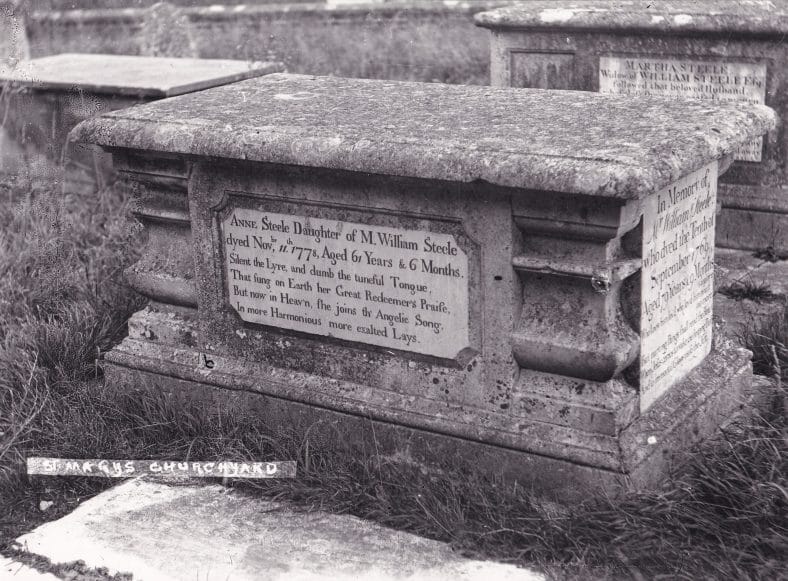
“Ineffable” is one of those two-dollar words I learned as an undergraduate, probably in some philosophy class I had no right to be in. (A two-dollar word in 1974 is worth $13.40 these days.) If something is ineffable, it means it cannot be expressed adequately. I quoted Cynthia Y. Aaalders in my previous essay on Anne Steele:
The prevalent themes in Steele’s hymnody gesture toward two related problems: problems pertaining to language and suffering. They are related in that together they concern the limited human ability to comprehend God and then articulate meaning about him. That is, together they raise questions in relation to the classic spiritual theme of the ineffability of God. Throughout the history of the church, Christian writers have probed the boundaries of speech and silence as regards the human ability to convey meaning about God. Steele's letters and verse reveal a similar concern. Her understanding of the limitations of language and her experience of personal suffering might reasonably be expected to have resulted in her silence. Yet in faith, Steele persisted in her efforts to compose hymns, and in so doing has put words in the mouths of many thousands of Christians—men and women, inarticulate and educated, confident and troubled by spiritual doubts.
Since writing that essay, I have had the opportunity to read all of Aalders’s book. I found it of some value, but I think it misses the mark about language. I don’t think Steele’s poetry, especially as it appears in the 2025 edition of The Sacred Harp, discusses language much. Suffering, yes; but language, no. On the other hand, Steele, time and time again, does express her gratitude and awe toward God, invoking God to aid her in understanding and expressing her praise.
In 258 INSPIRATION, she directly implores God to aid her:
Come, heav’nly love, inspire my song
With Thy immortal flame,
And teach my heart, and teach my tongue,
The Savior’s lovely name.
Dear Savior, let me call Thee mine;
I cannot wish for more.
Or ask God to show her the right way to express her love in 316 NEW HOPE1 :
Jesus, what shall I do to show
How much I love Thy charming name?
She implores God to so fill her with experiences of the divine that God would be praised and her own faults would fade from significance:
Unveil Thy beauties to my sight,
That I may love Thee more.
(488 RADIANCE)
The blessing of Thy grace impart,
And make me live to Thee.
(475 THANKFUL HEART)
O let me hear Thy blissful voice
Inspiring joys divine;
The barren desert shall rejoice
If only Thou art mine.
Thy presence, Lord, can cheer my heart
And raise my spirits high;
Thy smile can bid my pains depart
Though earthly comforts die.
(409 EXETER)
She even prays to God to overrule her own will, a wish to wish differently:
O turn us, turn us, mighty Lord,
By Thy resistless grace.
(354t LEBANON)
The reasons for her awe and wonder: First, it is God’s beautiful creation, as she expresses in 138t ADORATION:
Lord, when my raptured thought surveys
Creation’s beauties o’er,
All nature joins to teach Thy praise,
And bid my soul adore.
Second, it is God’s providence over creation, as she expresses in 301 GREENLAND:
His steady counsels change the face
Of each declining year;
He bids the sun cut short his race
And wintry days appear3 .
On us His providence has shone,
With gentle shining rays.
Not only has God created a beautiful world, God continues to sustain it.
Third, she is grateful for God’s revelation in Scripture:
Thy glory o’er creation shines,
But in Thy sacred Word
I read in fairer, brighter lines
My bleeding, dying Lord.
(488 RADIANCE)
Now, she is very much aware of humanity’s fallen nature: our failures and our sins. But she is radiant at “the sweet hope” of God’s redemption of humanity through that “bleeding, dying Lord.” This is a hope that can carry her throughout her (suffering) life, as she expresses in 475 THANKFUL HEART:
Let the sweet hope that Thou art mine
My life and death attend;
Thy presence through my journey shine,
And crown my journey’s end.
This hope extends beyond this life (507 WOODLANDS):
Hope looks beyond the bounds of time,
When what we now deplore
Shall rise in full immortal prime
And bloom to fade no more.
In the end, I think that Anne Steele has an easy relationship with the ineffability of God. Perhaps she is naive to have such a relationship. Anne Steele, a single woman of the 18th century, considers an all-powerful, but loving deity. Encouraged by her friends, rather than slip into silence, she erects an altar of praise: the books of poetry she published in her lifetime. As the words to 569t EMMAUS say:
O may the sweet, the blissful theme
Fill ev’ry heart and tongue,
Till strangers love Thy charming name,
And join the sacred song.
God may be ineffable, but Anne Steele does what she can. It is, in fact, God’s greatness that prompts her praise and adoration. God’s care for her, despite and through her physical suffering, leads her to worship and adore, and “with rapture trace the wonders of Thy love2 .”
We are perhaps more familiar with 32b DISTRESS and its mournful words:
So fades the lovely blooming flower,
Frail, smiling solace of an hour;
So soon our transient comforts fly,
And pleasure only blooms to die.
But the words that are repeated again and again in Steele’s poetry are God words like “Thee,” “Thy” and “Lord”; theological virtue words like “hope” and “love” and “grace”; and comforting words like “sweet” and, well, “comforts.” Anne Steele is not at a loss for words when considering the ineffable God. As Aalders writes, “Steele persisted in her efforts to compose hymns, and in so doing has put words in the mouths of many thousands of Christians—men and women, inarticulate and educated, confident and troubled by spiritual doubts.”
Program note
I think I will be taking the summer off from writing Vital Sparks essays.
Appendix
Songs with Anne Steele’s texts. Bolded songs are new to the 2025 edition of The Sacred Harp.
32b DISTRESS
54 RUSSELL
138t ADORATION
258 INSPIRATION
301 GREENLAND (verse 2)
316 NEW HOPE
323b KINGSWOOD
354t LEBANON
409 EXETER
475 A THANKFUL HEART
488 RADIANCE
494 HARRISON
507 WOODLANDS
511 THE GREAT REDEEMER (lines 1 and 2)
569t EMMAUS
1 Steele wrote verse 2 of 301 GREENLAND; Verse 1 is by Isaac Watts.
2 488 RADIANCE
3 Whoops, this verse is actually from Isaac Watts, too. Thank you, Robert T. Kelley!